Palladium Nanoparticles Dispersed in Alginate Beads as an Efficient, Eco‐friendly, and Sustainable Heteregeneous Catalyst: Testing in Carbon‐Sulfur and Carbon‐Carbon Cross‐Coupling Reactions
Von Wiley-VCH zur Verfügung gestellt
Abstract
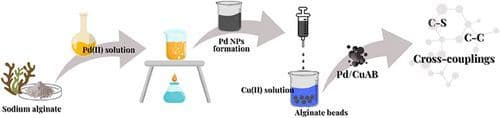
The development of sustainable and efficient catalysts featuring palladium nanoparticles (Pd NPs) is highly sought after. In this context, sodium alginate, a natural polymer, presents a promising eco-friendly support material for Pd NPs. Thus, this study reports the synthesis of a solid material which consists of sodium alginate beads containing uniformly dispersed Pd NPs (named palladium/copper alginate beads, Pd/CuAB). This material was fully characterized using analytical techniques of ultraviolet–visible spectrophotometry (UV–vis), Fourier transform infrared spectroscopy (FTIR), scanning electron microscopy (SEM), energy dispersive X-ray spectroscopy (EDS), transmission electron microscopy (TEM), and inductively coupled plasma optical emission spectrometry (ICP-OES). It is evaluated as a catalyst in both carbon-sulfur (C-S) and carbon-carbon (C-C) cross-coupling reactions. The catalytic system used for the C-S coupling demonstrated high efficiency and broad compatibility with substrates containing different substituent groups. For the Suzuki–Miyaura C-C coupling, the catalytic system showed excellent performance with aryl iodides as substrates. However, for aryl bromides, the results suggest that further optimizations are needed to achieve satisfactory reaction yields. Therefore, the Pd/CuAB catalyst showed surprising performance in C-S coupling and may be among the best described in the literature. In addition, the stability in air, ease of handling and use of sustainably sourced catalytic support are noteworthy points of the Pd/CuAB solid. Based on these results, this study contributes to the advancement of the state-of-the-art of palladium catalysts employing sustainable catalytic supports.