Oxadiazole Derivatives as Multifunctional Anticancer Agents: Targeting EGFR, PI3K/Akt/mTOR, and p53 Pathways for Enhanced Therapeutic Efficacy
Von Wiley-VCH zur Verfügung gestellt
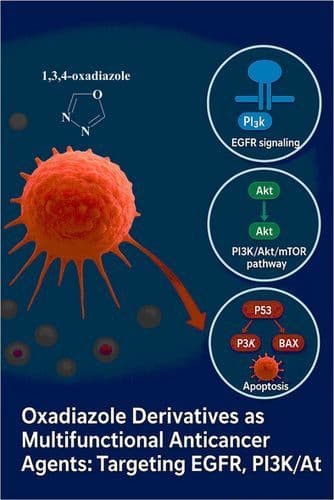
1,3,4-Oxadiazole derivatives exhibit potent anticancer activity by modulating multiple oncogenic pathways. They inhibit EGFR signaling, suppress the PI3K/Akt/mTOR cascade, and stabilize p53, thereby restoring apoptotic signaling through Bax activation. This multitarget regulation results in growth arrest and apoptosis of cancer cells, highlighting oxadiazoles as promising scaffolds for the development of next-generation anticancer agents.
Abstract
Oxadiazole derivatives are promising anticancer agents due to their ability to regulate the central molecular targets that play a crucial role in tumorigenesis. The current study provides an overview of their mechanism of action by highlighting major signaling pathways such as EGFR inhibition, PI3K/Akt/mTOR pathway inhibition, p53 upregulation, and ROS-induced cytotoxicity. Oxadiazole inhibition of EGFR blocks the Ras/Raf/MEK/ERK pathway, limiting tumor proliferation. Furthermore, the compounds block the PI3K/Akt/mTOR pathway, restoring PTEN activity and promoting apoptosis. Moreover, oxadiazoles enable tumor suppression by stabilizing p53, blocking its degradation via MDM2 binding, and thus activating pro-apoptotic genes. Moreover, their ability to induce ROS selectively initiates oxidative stress in cancer cells, causing DNA damage and mitochondrial dysfunction. Mechanistic information provided in the current study highlights the versatile nature of oxadiazoles as anticancer agents, with an emphasis on their potential to be utilized in clinical contexts. Biochemical pathways of metastatic melanoma, as presented by molecular pathway analysis, further strengthen the importance of these compounds against oncogenic pathways. Due to their multiplicity of mechanisms, oxadiazoles hold a promising target for targeted cancer therapy, justifying further investigation of their structure-activity relationships, pharmacokinetics, and in vivo activity. The current study provides a critical platform for the rationale design and development of next-generation oxadiazole-based anticancer agents.