Metal‐Responsive Up‐Regulation of Bifunctional Disulfides for Suppressing Protein Misfolding and Promoting Oxidative Folding
Von Wiley-VCH zur Verfügung gestellt
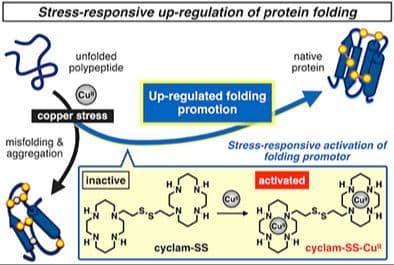
A stress-responsive folding promotor was developed by conjugating metal-binding ligands and a redox-active disulfide. The oxidative strength of the bifunctional disulfide was enhanced by metal coordination, inhibiting protein misfolding and up-regulating the oxidative folding capacity under metal stress. The disulfide compound also promoted oxidative folding of a pharmaceutical peptide and was used to suppress pathological protein aggregation.
Abstract
The stress-responsive up-regulation process is a sophisticated biological response to maintain cellular homeostasis. In intracellular anti-oxidant systems, the expression level of oxidoreductases is up-regulated under oxidative stress, mitigating oxidative damage on biomolecules and enhancing protein folding capacity. Herein, inspired by the biological system, we developed a synthetic folding promotor whose reactivity is up-regulated under stress conditions. We conjugated two metal-binding 1,4,7,11-tetraazacyclotetradecane (cyclam) ligands and a redox-active disulfide to obtain cyclam-SS, whose reactivity can be enhanced under metal-induced stress. Metal coordination increased the redox potential of cyclam-SS, activating it as an oxidant. While CuII ions severely hampered the oxidative folding of substrate polypeptides, cyclam-SS exhibited bifunctional folding-promoting properties, i) suppressing CuII-mediated misfolding and aggregation, and ii) harnessing CuII to enhance oxidative folding. Cyclam-SS was also useful for disulfide-bond formation to promote oxidative folding of pharmaceutical and pathological proteins, as demonstrated with proinsulin and superoxide dismutase 1 (SOD1). Furthermore, cyclam-SS protected cultured cells from copper-induced stress. Thus, we demonstrated the induction of the stress-responsive up-regulation process by a bifunctional folding promotor controlling the folding status of biologically important proteins under metal-induced stress. The strategy of “stress-responsive up-regulation” could aid the development of novel synthetic materials for treating intracellular stress and related disorders.