Mandarin Peel‐Derived Carbon‐Supported PtPd Catalysts for the Electro‐Oxidation of Glycerol in Alkaline Medium
Von Wiley-VCH zur Verfügung gestellt
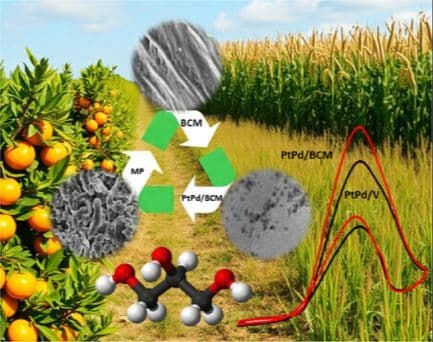
Mandarin peel-derived biocarbons (BCM) are prepared via fast pyrolysis at low temperatures. BCM powders are used as support for the preparation of PtPd catalysts. PtPd/BCM catalysts perform better for the glycerol oxidation reaction (GOR) than the bimetallic system supported on Vulcan. It is observed that BCM supports induce a strong metal–support interaction and supply labile –OH groups for the oxidation of the adsorbed intermediates during the GOR process.
In this work, mandarin peel-derived biocarbons synthesized by fast pyrolysis are tested as support materials for PtPd nanoparticles for the electrochemical oxidation of glycerol in an alkaline electrolyte. The biocarbons, synthesized at 300 °C (mandarin peel-derived biocarbons (BCM)-300) and 500 °C (BCM-500), present good electronic conductivities and adequate surface properties. Bimetallic PtPd nanoparticles with average sizes between 3.5 and 3.9 nm and a Pt:Pd ratio of 3:1 are deposited over the biocarbons by a pulse microwave-assisted polyol method. The electrochemical experiments show that the mass-specific activity for the glycerol oxidation reaction of the PtPd particles supported over the biocarbons is higher than that reported for the bimetallic catalyst deposited over Vulcan carbon black. In addition, the catalyst deposited over the biocarbons presents lower potential onsets, lower apparent activation energies, and lower charge transfer resistances compared to the bimetallic particles supported over the commercial carbon material. The superior electrocatalytic performance of PtPd/BCM-300 and PtPd/BCM-500 catalysts is attributed to the synergistic effect between the bimetallic particles and the biocarbons, which promotes glycerol oxidation through both the electronic effects and the bifunctional mechanism.