Kinetic Modeling of the Ru‐MACHO‐Catalyzed CO2 Hydrogenation to Methanol
Von Wiley-VCH zur Verfügung gestellt
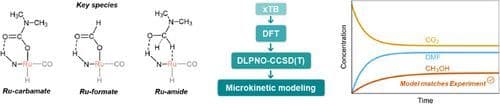
In this study, computational methods combined with microkinetic modeling identified Ru-formate 3 as the primary resting state and revealed that methanol production proceeds through a metal-ligand cooperative mechanism and an hemiaminal intermediate, which is decomposed by a methanol-assisted pathway. Increasing dimethylamine concentration was found to enhance the methanol turnover number, consistent with experimental observations.
Abstract
One of the most efficient and extensively studied homogeneous catalysts for CO2 hydrogenation to methanol is the Ru-MACHO-Ph complex. However, the exact nature of the resting states of the catalyst, which could be Ru-formate, Ru-carbamate, and [Ru-CO]⁺, as well as the contribution of various pathways for amide hydrogenation, remain unresolved questions. In this study, we employed a computational protocol including conformational search with a semiempirical method (GFN2-xTB), followed by geometry optimization and energy calculations using density functional theory (M06/M06L) and coupled-cluster (DLPNO-CCSD(T)) methods to investigate the most plausible pathways for the CO2 hydrogenation reaction assisted by dimethylamine (DMA). Microkinetic modeling was used to predict the methanol turnover number (TON), which aligns well with experimental data, and to analyze the proposed mechanisms and resting states of the catalyst. Our model indicates that dimethylformamide (DMF) is initially hydrogenated to hemiaminal through a metal-ligand cooperative mechanism. The resulting hemiaminal is then decomposed via a methanol-assisted organic reaction in a catalyst-independent process. Additionally, Ru-formate (3) was identified as the primary resting state, along with Ru-carbamate (8). Furthermore, we found that increasing the DMA concentration enhances the methanol TON, in agreement with previous experimental results.