Interfacial Preferential Adsorption and Molecular Mobility Restriction Enabling 3.2 V High Voltage Supercapacitor
Von Wiley-VCH zur Verfügung gestellt
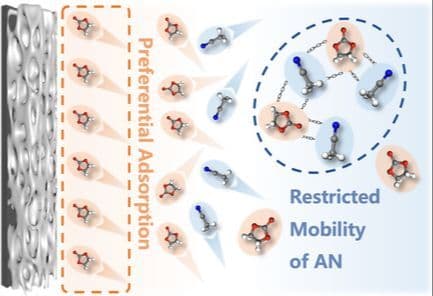
In the acetonitrile (AN)-ethylene carbonate (EC) electrolyte, the electrochemically stable EC molecules preferentially adsorb onto electrode interface and simultaneously reduce AN diffusion rates through strong intermolecular interactions, leading to the suppression of AN-electrode contact and associated decomposition risks. This novel electrolyte with superior electrochemical stability enables the 3.2 V high voltage supercapacitor operation.
The narrow voltage window of current commercial supercapacitors severely restricts their energy storage performance, primarily due to the severe side reactions such as oxidation and polymerization of free acetonitrile (AN) molecules at high-voltage electrode interfaces. Although traditional electrolyte engineering strategies employ oxidation-resistant substances like fluorinated compounds or ionic liquids to optimize the high-voltage performance of supercapacitor, they fail to effectively suppress the aggressive AN interfacial decomposition. Herein, ethylene carbonate (EC) is introduced into AN-based electrolyte (AN-EC electrolyte), significantly enhancing the systematic electrochemical stability. Theoretical calculations and experimental characterizations reveal that EC molecules, with superior electrochemical stability, preferentially adsorb onto electrode interfaces and simultaneously reduce AN diffusion rates through strong intermolecular interactions, leading to the suppression of AN-electrode contact and associated decomposition risks. Benefiting from this dual-protective mechanism, the supercapacitor based on AN-EC electrolyte achieves a high voltage window of 3.2 V, enhanced cycling stability (70% capacity retention after 30,000 cycles at 3.2 V), and superior energy and power densities (33.3 W h kg−1@749 W kg−1 and 17.6 W h kg−1@9,883 W kg−1, respectively). This study provides a valuable framework for designing electrolytes with optimized electrochemical stability.