H2 Production from Ammonia Borane: Integrating Experiments, Computational Fluid Dynamics, and Statistical Analysis for Predicting and Optimizing Process and Reactor Design
Von Wiley-VCH zur Verfügung gestellt
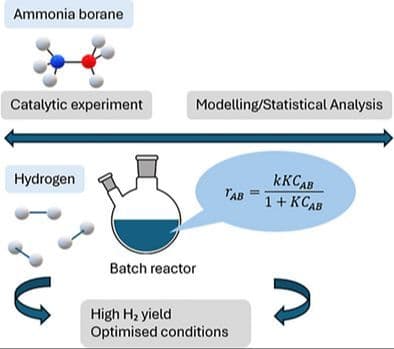
Ammonia borane is considered a great hydrogen carrier, and when hydrolyzed, it can generate 3 moles of H2. This study highlights the combination of experimental and computational work, such as modeling and statistical analysis, that enables future experimentation by focusing on the parameter with the most profound effect on maximum H2 yield.
Abstract
In this study, an iridium catalyst (Ir/Ni10Ce) was used for the catalytic hydrolysis of ammonia borane (AB). The parameters tested were temperature, stirring rate, AB concentration, and AB-to-catalyst molar ratio. By integrating a simple Langmuir–Hinshelwood kinetic in a computational fluid dynamics (CFD) simulation, the experimental results were validated with a maximum error of 13% observed at only two experimental conditions, while on the rest it was lower than 10%, showcasing the robustness of the model. In all experimental cases, AB resulted in over 85% H2 yield. Statistical analysis was also implemented to uncover the effect of the four main factors: temperature, stirring rate, AB concentration, and substrate (AB) to catalyst ratio, on the three response variables: reaction time, TOF, and H2 yield. Radar plots are also presented, illustrating how two-factor interaction influences the response variables. By combining temperature with either concentration or catalyst amount, a profound effect on the reaction time was observed. The combination of experimental work along with computational work of CFD and statistical analysis can significantly enhance a reaction process by targeting the most impactful factors, allowing experiments with optimized reaction conditions for better results in terms of H2 yield and catalytic performance. Considering also the interaction of the variables enables further process optimization by focusing on specific parameter combinations without wasting resources.