Growth of Carbon Nanotubes on Co(x)‐Ni(1‐x) Ferrites by Chemical Vapor Deposition and Performance on Catalytic Wet Peroxide Oxidation
Von Wiley-VCH zur Verfügung gestellt
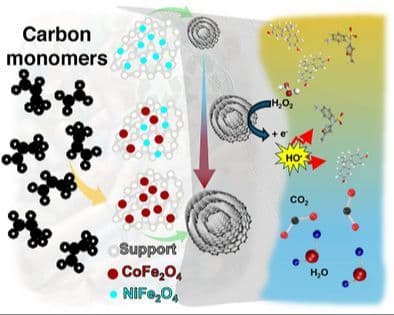
This study presents a sustainable approach for synthesizing carbon nanotubes (CNTs) via chemical vapor deposition (CVD) using polyolefins as model plastic waste as the carbon source and Ni─Co ferrite catalysts. The CNTs were applied in catalytic wet peroxide oxidation (CWPO) to degrade bisphenol A (BPA) and sulfamethoxazole (SMX), achieving efficient pollutant removal via hydroxyl radical (•OH) generation.
Abstract
Upcycling plastic solid wastes (PSWs) into high-value carbon nanotubes (CNTs) offers a promising approach to sustainable material development. This study explores the synthesis of CNTs via chemical vapor deposition (CVD) using mixed cobalt-nickel-iron oxide catalysts supported on alumina and PSW representative polyolefins as carbon sources. The impact of catalyst composition on the yield, morphology, and textural properties of CNTs was systematically evaluated. Characterization techniques, such as textural properties, transmission electron microscopy (TEM), Raman spectroscopy, and thermogravimetric analysis (TGA), revealed that increasing cobalt content in the catalyst resulted in thicker CNT walls (9.2–23.6 nm) and different textural properties (S BET = 47–87 m2 g−1). The synthesized CNTs were then tested in catalytic wet peroxide oxidation (CWPO) for the degradation of sulfamethoxazole (SMX) and bisphenol A (BPA) in both single- and multi-component systems. The results indicated that a higher cobalt content in the CNT catalysts enhanced catalytic activity, particularly for BPA degradation, due to improved H2O2 decomposition. However, a higher leaching of Co and Fe was also observed. The CNTs synthesized with a Co/Ni catalyst composition ratio of 7/3 (CNT@Co0.7Ni0.3) exhibited the best balance among the tested materials in terms of CNTs yield, catalytic activity, and stability. These findings provide valuable insights to optimize CNT catalysts derived from waste plastics for environmental remediation applications.