Fiber‐Particle Composite Binder Enabled Feasibly Dry‐Processed Ultrahigh‐Nickel Cathode Film for All‐Solid‐State Lithium Batteries
Von Wiley-VCH zur Verfügung gestellt
The particle-fiber composite binder enhances dry-processed cathode performance by improving film cohesion and mitigating contact failure arising from volume changes and side reactions. As the result, ionic and electronic conduction inside are improved, boosting both rate performance and cycling stability.
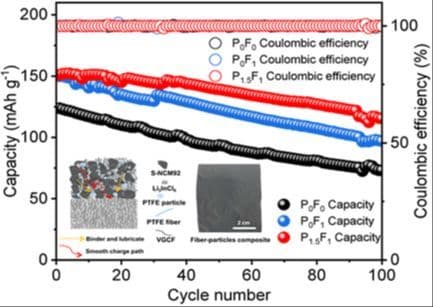
Cathodes play a critical role in determining the performance of all-solid-state lithium batteries (ASSLBs). Traditional dry-processed cathode based on only fibrous binder suffers from limited binder fibrillation and loose contact between solid particles inside. Herein, a fiber-particle composite binder is employed to fabricate a dry-processed cathode comprising single-crystal LiNi0.92Co0.05Mn0.03O2 (S-NCM92) and Li3InCl6 (LIC). The incorporation of 1.5 wt% polytetrafluoroethylene (PTFE) particles and 1 wt% PTFE fibers promotes interparticle contact, thereby enhancing the mechanical adhesion among solid components. As the result, the optimized dry-processed cathode shows a marked improvement in rate capability and cycling stability. Moreover, the dry-processed cathode with fiber-particle composite binder enables a pouch cell with a capacity of 10.89 mAh to exhibit 68.8% capacity retention after 80 cycles under a stack pressure of 31.25 MPa. The cell maintains electrochemical function after cutting, demonstrating its safety and reliability. These results underscore the practicality of the fiber-particle composite binder strategy to fabricate high-quality cathodes for ASSLBs.