Efficient Photocatalytic Hydrogen Evolution via Band‐Engineered Reverse Type‐II InP/CdS Core/Shell Quantum Dots
Von Wiley-VCH zur Verfügung gestellt
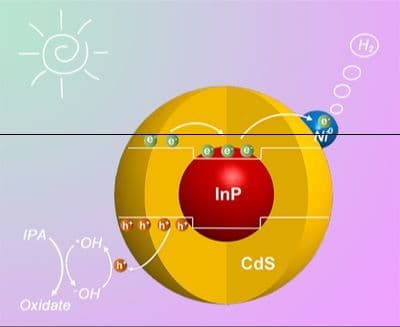
In the reverse Type-II InP/CdS core/shell QDs, the epitaxial CdS shell growth enables surface defect passivation while minimizing interfacial lattice mismatch between the core and shell. Additionally, the reverse Type-II heterostructure facilitates spatial charge separation through migrating the holes toward the QDs surface, thereby the prepared core/shell QDs exhibit superior photocatalytic activity and stability.
Abstract
Quantum dot (QD)-based photocatalysts show promise for H2 production due to their unique properties. To mitigate the disadvantages caused by surface defects, core/shell engineering is typically used for surface passivation. However, in conventional Type-I and Type-II heterostructure QDs, the valence band (VB) of the shell is more positive than that of the core, creating the thermodynamic barrier for holes migration from core to shell, leading to further deterioration of the rate-determining step in the photocatalytic systems. Herein, the reverse Type-II core/shell QDs of InP/CdS are synthesized by epitaxially growing the CdS shell on the InP QDs. The CdS shell coverage would not only effectively passivate the surface defects of InP QDs, but also forms a reverse Type-II heterojunction which the VB of CdS shell is more negative than that of InP core. This band alignment generates a thermodynamic driving force for directional hole migration to the CdS surface, thereby accelerating the rate-limiting hole transfer process. Under optimal conditions, the InP/CdS QDs exhibit excellent photocatalytic activity and stability, which the H2 evolution rate could reach 63.43 ± 5.1 µmol mg−1 h−1 during the initial 40 h reaction, giving the turnover number (TON) value of 376,840 per QD under 60 h irradiation.