Dual‐Sided Multidentate Coordination Strategy Enables Record Birefringence in UV‐Transparent Antimony‐Based Hybrid Crystals
Von Wiley-VCH zur Verfügung gestellt
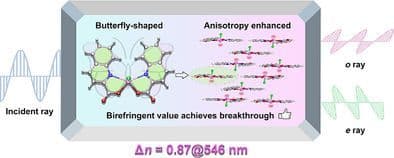
A butterfly-shaped UV-transparent hybrid birefringence crystal, (C10H6NO2)2SbF (QCSF), with a record-breaking birefringence of 0.87 at 546 nm, surpassing all previously reported halide birefringent crystals with SCALPs, was successfully designed and synthesized through a dual-sided multidentate coordination strategy.
Abstract
Achieving ultrahigh birefringence in UV-transparent materials remains fundamentally constrained by the trade-off between strong optical anisotropy and wide bandgap transparency. Herein, we report a dual-sided multidentate coordination (DMC) strategy to construct two butterfly-shaped UV organic–inorganic hybrid crystals—(C6H4NO2)2SbF (PCSF) and (C10H6NO2)2SbF (QCSF)—in which planar π-conjugated bidentate ligands symmetrically chelate stereochemically active lone pair (SCALP) Sb3+ centers. This coordination architecture enforces coplanar alignment of optical functional units and promotes dense π–π stacking, thereby significantly enhancing macroscopic birefringence. Notably, QCSF achieves a record-high birefringence of Δn = 0.87 at 546 nm, surpassing all previously reported lone-pair-containing halide crystals with UV transparency. The exceptional optical performance is attributed to the unique [SbN2O2F] coordination geometry, near-planar molecular configuration, and extended π-electron delocalization. First-principles calculations reveal that the observed anisotropy stems from synergistic orbital coupling between the Sb centers and the π-conjugated organic ligands. This work introduces a broadly applicable molecular design paradigm for next-generation birefringent crystals that simultaneously offer high optical anisotropy and UV transparency.