Donor–Acceptor Covalent Organic Frameworks for Photocatalytic Water Oxidation and Oxygen Reduction Reactions
Von Wiley-VCH zur Verfügung gestellt
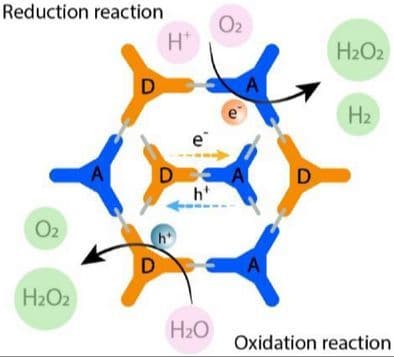
An alternative arrangement of electron–donor (D) and electron-acceptor (A) units in the covalent organic framework (COF) backbone increases strong visible light absorption, tunes the optical bandgap, and facilitates charge separation and transport, resulting in improved photocatalysis for water oxidation and oxygen reduction reactions, key processes in the production of hydrogen and hydrogen peroxide.
Abstract
Covalent organic frameworks (COFs) are considered as the next generation of organic photocatalysts for the conversion of solar energy into fuels or chemicals. Compared to the traditional heterogeneous photocatalysts, COFs have emerged as organic photocatalysts and have been tested for various photocatalytic transformations such as hydrogen evolution, hydrogen peroxide generation, carbon dioxide reduction and organic transformations. In particular, donor–acceptor (D–A) COFs showed enhanced photocatalytic activity, where electron-rich donor (D) and electron-deficient acceptor (A) are alternately arranged in the framework. The high photocatalytic activity of D–A COFs is attributed to the tunable band gap, efficient charge separation and charge transport through the bicontinuous heterojunction. In recent years, several D–A COFs have been reported for photocatalytic reactions, especially tested for photocatalytic generation of hydrogen and hydrogen peroxide involving water oxidation and oxygen reduction reactions. In this review, we have summarized these reports and presented a critical perspective with the fundamental understanding of D–A COFs. In addition, this review discusses the different design principles adopted and the synthesis of crystalline D–A COFs with different linkages and their effect on the photocatalytic efficiency. Finally, this review will provide an overview of the design of D–A COFs for photocatalysis, addressing the challenges and opportunities involved.