Design and Synthesis of β‐Carboline Hydrazone Hybrids as New α‐Amylase and α‐Glucosidase Inhibitors: Inhibition Kinetics and Molecular Docking Studies
Von Wiley-VCH zur Verfügung gestellt
The current study has successfully designed and synthesized a series of β-carboline hydrazone hybrids as new α-amylase and α-glucosidase inhibitors. Inhibition kinetic analysis revealed that they are competitive-type inhibitors of α-amylase and non-competitive type inhibitors of α-glucosidase. Molecular docking studies suggest that the origin of binding affinities stems from both hydrophobic and hydrophilic binding interactions.
Abstract
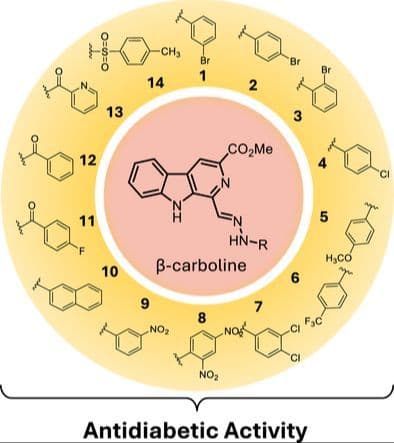
Diabetes mellitus (DM) is a chronic metabolic disorder that has been flagged as a global threat with progression at an alarming rate worldwide. The dual inhibition of carbohydrate hydrolases, α-amylase, and α-glucosidase, has been considered one of the most coveted approaches for diabetes management. In view of hybrid compounds that usually exhibit greater affinity and efficiency, we have designed and synthesized a series of β-carboline hydrazone hybrids (1–14) as new α-amylase and α-glucosidase inhibitors. Compared to standard acarbose, the synthesized compounds exhibited promising α-amylase and α-glucosidase inhibition with IC50 values ranging between 1.99–8.23 mM and 1.62–9.09 mM, respectively. Compound 11 (IC50 = 1.99 ± 0.18 mM) turned out to be the most active against α-amylase enzyme, whereas 9 (IC50 = 1.62 ± 0.11 mM) displayed the highest inhibitory activity against α-glucosidase. Inhibition kinetic analysis of selected compounds revealed that they are competitive-type inhibitors of α-amylase and noncompetitive-type inhibitors of α-glucosidase. Molecular docking studies of compounds 1–14 suggest that the origin of binding affinities stems from both hydrophobic and hydrophilic binding interactions. The chemical structures of compounds 1–14 was extensively characterized by spectroscopic methods, including 1H- and 13C-NMR, and IR spectroscopy.