Catalytic Polymerization of n‐Doped Poly(benzodifurandione) (n‐PBDF) Using Parts Per Million (ppm) Levels of Molybdenum Trioxide
Von Wiley-VCH zur Verfügung gestellt
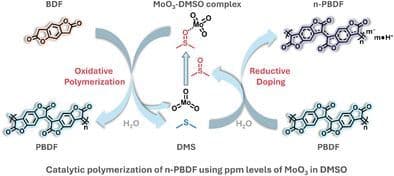
An efficient, scalable, and cost-effective catalytic polymerization of n-PBDF using ppm levels of MoO3 was developed in this study. Kinetic studies reveal that this polymerization demonstrates chain-growth characteristics, enabling the preparation of high-quality n-PBDF polymers. Mechanistic investigations reveal that MoO3 mediates an oxidative pathway involving dimethyl sulfoxide (DMSO), with dimethyl sulfide (DMS) identified as the reduction product. This method eliminates the need for purification process, demonstrating the potential for large-scale production of high-quality n-PBDF ink.
Abstract
The recent discovery of highly conductive, solution-processable, n-doped poly(benzodifurandione) (n-PBDF) has significantly pushed the boundaries of organic electronics. However, to maximize its practical impact, an efficient, scalable and cost-effective synthetic method is essential. Initially, n-PBDF was synthesized via duroquinone-mediated or copper-catalyzed polymerizations, but these methods required prolonged dialysis, limiting their scalability. Our recent SeO2-catalyzed polymerization improved efficiency but still necessitated centrifugation and filtration to remove solid selenium byproducts. In this work, we introduce a highly efficient molybdenum trioxide (MoO3)-catalyzed polymerization of n-PBDF. Remarkably, MoO3 at parts-per-million (ppm) concentrations achieves near-quantitative monomer conversion (>99% by NMR), eliminating the need for purification. Kinetic studies demonstrate that this polymerization follows a chain-growth mechanism, enabling the synthesis of high-quality n-PBDF polymers with controlled particle sizes and block copolymers. Mechanistic investigations reveal that MoO3 mediates an oxidative pathway involving dimethyl sulfoxide (DMSO), with dimethyl sulfide (DMS) identified as the reduction product. This innovation not only provides a scalable, low-cost route to high-quality n-PBDF but also unlocks new synthetic opportunities, significantly expanding the synthetic toolbox for functional polymers.