Balancing Tetrahedral and Cation Entropies for Long‐lifespan Low‐temperature Zn‐ion Batteries
Von Wiley-VCH zur Verfügung gestellt
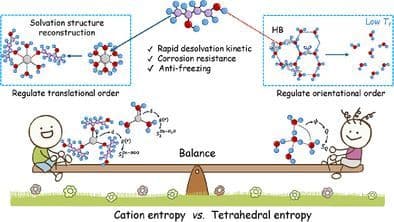
A strategy is proposed to enhance low-temperature cycling stability in aqueous zinc-ion batteries by balancing tetrahedral and cation entropies in hybrid electrolytes. By optimizing solvent ratios, the trend of the two entropy values is quantitatively analyzed and optimized, so as to maintain high cyclic stability while having excellent freezing resistance.
Abstract
Aqueous Zn-ion batteries (AZIBs) are promising candidates for next-generation energy storage. However, their application is hindered by Zn anode instability and reduced ionic conductivity at low temperatures. Here, we identified two decisive factors for low-temperature performance and anode stability of batteries: tetrahedral entropy and cation entropy. The former is closely related to antifreezing ability of electrolyte, while the latter is associated with the desolvation kinetics of Zn2+. We propose an effective strategy to balance the above two thermodynamic quantities by precisely tuning the molar fraction of the 1,3-butanediol (BDO) cosolvent with notable glass-forming ability. BDO enhances the tetrahedral entropy due to the disruption of the hydrogen-bond networks among water molecules, decreasing the solid–liquid transition temperature from −16.4 to −101 °C. Additionally, BDO modifies the solvated structure of Zn2⁺ to limit the active water content, thus suppressing by-reactions at the electrode/electrolyte interface. The optimized electrolyte enables long-term cycling of Zn||Zn symmetric cells for over 4000 h at −40 °C under 0.1 mA cm−2/0.1 mAh cm−2, and renders PANI||Zn full cells capable of working across a broad temperature range (−40 °C to 60 °C). This work offers a guideline to design stable and low-temperature AZIBs, expanding the application scope for aqueous electrolytes.