Archaeometric Analyses of Medieval Pottery from the Lower Danube Region, Romania
Von Wiley-VCH zur Verfügung gestellt
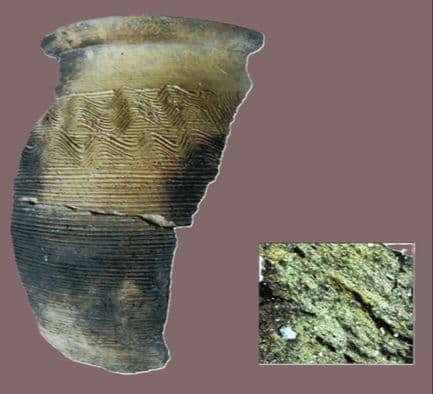
This study is about the pottery manufacturing in the Lower Danube region during the Early Medieval period (8th–10th c. AD). Optical microscopy, Particle induced X-ray emission, and X-ray diffraction analyses performed on 32 representative ceramic shards excavated at Pantelimonu de Sus, Constanţa County, Romania, provide clues on the raw materials and craftsmen skills.
This study discusses the pottery manufacturing in the Lower Danube region during the Early Medieval period. Optical microscopy, Particle induced X-ray emission (PIXE), and X-ray diffraction (XRD) are performed on 32 ceramic shards unearthed at Pantelimonu de Sus, Constanţa County, Romania, dated to the 8th–10th c. AD. The petrographic observations show an important variability in terms of mineral composition, homogeneity, and porosity, documented by the presence of four types of ceramic paste, three indicating the use of alluvial clays and one suggestive for kaolinitic clays. The mineralogy of selected ceramic fragments is further refined by powder XRD. The principal component analysis of the PIXE data separates the fragments made of kaolinitic clays from the rest. The archaeometric investigations show that during the Early Middle Age, the potters from Pantelimonu de Sus use alluvial and kaolinitic clays, most likely of local or regional origin to manufacture various kind of vessels. Most potteries are fired in an oxidizing atmosphere—complete or incomplete—at temperatures ranging from 600 °C to 900 °C. The analytical data are compared to those previously obtained on coeval ceramic finds from some nearby archaeological sites; a certain degree of similarly of the results is evidenced.