Amorphous Nitride‐chloride Solid‐State Electrolytes for High Performance All‐Solid‐State Lithium Batteries
Von Wiley-VCH zur Verfügung gestellt
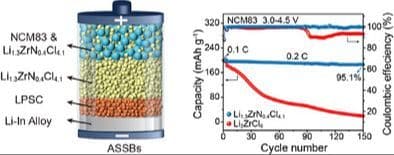
An amorphous nitrogenchloride dual-anion solid-state electrolyte (Li1.3ZrN0.4Cl4.1) with high ionic conductivity (3.01 mS cm−1 at 25 °C) and broad electrochemical stability is developed. When paired with LiNi0.83Co0.06Mn0.11O2, it enables all-solid-state batteries (ASSBs) with high capacity (200.1 mAh g−1 at 4.5 V), excellent cycle retention (95.1% after 150 cycles), and long-term durability (3,000 cycles at 3 C). The electrolyte remains stable under extreme conditions, operating at 4.8 V and 50 °C, demonstrating strong potential for high-energy, long-life ASSBs.
Abstract
High-performance solid-state electrolytes (SSEs) are crucial for advancing all-solid-state batteries (ASSBs). Amorphous SSEs, in particular, offer promising advantages due to their grain-boundary-free nature, which facilitates intimate solid-to-solid contact and uniform lithium-ion flux, thereby improving composite electrode performance. Here, we report a class of SSEs based on a nitrogen–chlorine dual-anion framework, formulated as Li3 x +0.1ZrN x Cl4.1, for high-voltage ASSBs. Unlike widely studied crystalline Li2ZrCl6 with a triclinic structure, increased N3− substitution drives a structural transition to an amorphous phase (Li1.3ZrN0.4Cl4.1), which achieves a significant enhancement in Li+ conductivity from 0.46 to 3.01 mS cm−1, alongside improved oxidative stability up to 4.8 V. This dual-anion SSEs exhibits excellent compatibility with high-energy LiNi0.83Co0.06Mn0.11O2 (NCM83) cathodes. The corresponding full cells deliver a high reversible capacity of 200.1 mAh g−1 at 4.5 V with outstanding capacity retention of 95.1% after 150 cycles at 0.2 C, along with remarkable long-term cycling stability exceeding 3000 cycles at 3 C. Furthermore, the electrochemical stability of Li1.3ZrN0.4Cl4.1 in conjunction with NCM83 is still preserved under elevated temperatures (50 °C) and higher cut-off voltages (up to 4.8 V). These results highlight the promise of dual-anion amorphous electrolytes, paving the way for the design of next-generation SSEs beyond traditional single-anion systems.