Alkali Metal Cations Impact the Selectivity of Radical‐Mediated Electrochemical C─H Chlorination
Von Wiley-VCH zur Verfügung gestellt
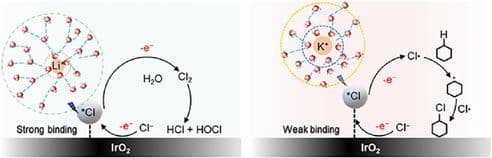
In this work, we found that alkali metal cations in the electrolyte can impact the *Cl binding energy, which controls selectivity between radical-mediated electrochemical C─H chlorination and competing Cl2 formation.
Abstract
Electrochemistry offers a promising route toward facilitating organic transformation reactions in a sustainable manner. However, there are often a multitude of factors at play; hence, it can be unclear how operating conditions can be rationally tuned to optimize selectivity. Here, we demonstrate how the identity of alkali metal cations in the electrolyte can control the selectivity of electrochemical C─H chlorination. Specifically, we obtained a 90.3% Faradaic efficiency with KCl as compared to 78.4% with LiCl for the conversion of cyclohexane to chlorocyclohexane at 1000 mA using an IrO x electrode. Electron paramagnetic resonance spectroscopy experiments indicate a greater propensity for Cl− oxidation to generate Cl radicals in the order: K+ > Na+ > Li+. This leads to an increase in the selectivity toward the chlorination of cyclohexane and a concomitant decrease in competitive Cl2 formation. Density functional theory calculations and in situ Raman spectroscopy experiments indicate that this is likely due to a decrease in *Cl binding energy on IrO x in the presence of K+. These findings highlight the important role of alkali metal cations, which can be a key consideration for designing electrochemical organic synthesis systems.