Adjusting Chemical Hardness–Softness Balance of Electrolyte to Enable High‐Voltage Reversible Fluoride Ion Batteries
Von Wiley-VCH zur Verfügung gestellt
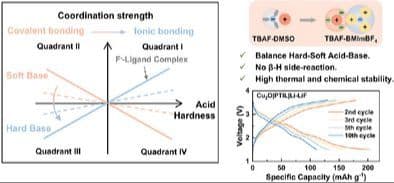
An electrolyte system based on tetrabutylammonium fluoride salt and 1-butyl-3-methylimidazolium tetrafluoroborate ionic liquid solvent is designed based on anion–cation coordination engineering and hard–soft-acid–base balance modulation. The soft-acid BMIm⁺ participates in the solvation structure of hard-base fluoride ions, effectively expanding the electrochemical window and cycling life of fluoride ion batteries based on Cu2O cathode.
Abstract
Fluoride ion batteries (FIBs), as a promising next-generation high-energy-density storage technology, have attracted significant attention. However, developing an ideal fluoride-ion electrolyte that suppresses the β-H abstraction (caused by strong Lewis-basicity F−) and electrolyte decomposition remains challenging. To address this bottleneck, we design an electrolyte system based on commercial tetrabutylammonium fluoride (TBAF) salt and 1-butyl-3-methylimidazolium tetrafluoroborate (BMImBF4) ionic liquid solvent through anion–cation coordination engineering and hard–soft-acid–base (HSAB) balance modulation, unveiling its multiscale mechanisms for mitigating interfacial parasitic reaction and enhancing metal anode stability. Experimental and theoretical analyses reveal that the soft-acid BMIm⁺ participates in the solvation structure of hard-base fluoride ions, effectively blocking the β-H elimination pathway and expanding the electrochemical window to 4.5 V. The ionic conductivity of this ionic liquid based electrolyte reaches 5.0 × 10⁻³ S cm−1 at 60 °C even after in situ polymerization. The Cu2O cathode coupling insertion and conversion reactions can alleviate the volume deformation and capacity decay of Cu2O||Li–LiF high-voltage FIBs, with a high resting voltage (2.91 V) and a high initial capacity of 589.9 mAh g−1. The Cu2O||Pb–PbF2 FIBs maintain a high reversible capacity of 243.6 mAh g−1 even after 800 cycles under 200 mA g−1. The work establishes a novel electrolyte design paradigm for high-voltage reversible FIBs.