ARTIKEL

A Review on MOFs as Efficient Fluorometric Chemosensors for Metal Ions
13.08.2025
A Review on MOFs as Efficient Fluorometric Chemosensors for Metal Ions

Von Wiley-VCH zur Verfügung gestellt

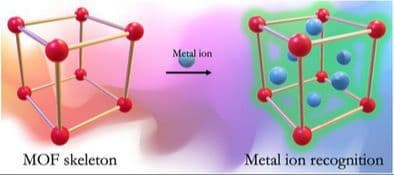
The review discusses the MOFs of transition, lanthanide, and alkaline earth metals that are widely used as chemosensors in the detection of different metal ions.


Abstract

MOFs are extensively utilized for recognizing metal ions. With their tunable structures, opportunities for postsynthetic modification, and chemical stability, MOFs outperform current alternatives by providing unique spectroscopic readings for metal ion detection. We find their recyclability particularly appealing, as it allows repeated use of the same host probe—this aspect is crucial for point-of-care technologies. This review offers an in-depth exploration of metal ion recognition through MOFs, including insights into sensing mechanisms and photophysical properties sourced from more than 130 articles. It serves as a valuable reference for those interested in a comprehensive understanding of knowledge.

Verwandte Artikel

A Review on MOFs as Efficient Fluorometric Chemosensors for Metal Ions
Organic Fluorophores for Studying Lipid Membrane Structures and Dynamics
A Review on MOFs as Efficient Fluorometric Chemosensors for Metal Ions
Phosphine‐Free NNN Pincer Supported Cu(II) Catalysts for Sustainable Multi‐Component Synthesis of Pyrazolines and Pyrimidines via Dehydrogenation of Renewable Primary Alcohols
A Review on MOFs as Efficient Fluorometric Chemosensors for Metal Ions
CBr4 as an Efficient Halogen Bond Donor Catalyst in Pictet–Spengler Cyclizations: A Metal‐Free Approach to the Synthesis of Benzazepinoindoles and Tetrahydro‐β‐carbolines
A Review on MOFs as Efficient Fluorometric Chemosensors for Metal Ions
Stimuli‐Responsive Supramolecular Polymers of Mono‐ and Bis‐triazolylphenylazoaniline‐Functionalized Copillar[5]Arenes: With Distinctive Binding Modes
A Review on MOFs as Efficient Fluorometric Chemosensors for Metal Ions
From Inception to Innovation: 20 Years of Nanoarchitectonics