A Genetically Encoded Homocysteine Precursor to Probe Protein Active Sites and to Addict Escherichia coli to a Noncanonical Amino Acid Directly Involved in Catalysis
Von Wiley-VCH zur Verfügung gestellt
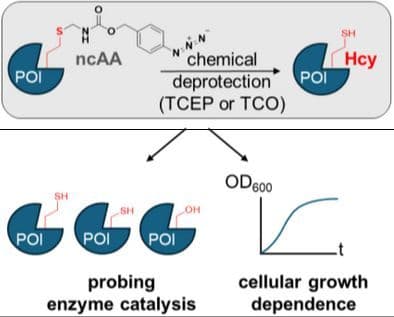
A new genetically encoded amino acid is chemically converted into homocysteine (Hcy) under mild conditions to probe and to activate protein active sites. Surprisingly, Hcy can replace cysteine or serine residues in several enzymes. Its potential for a widespread use in proteins is further underlined by rendering Escherichia coli dependent on Hcy, providing the first link between cell survival and a noncanonical amino acid directly involved in biocatalysis.
Abstract
Noncanonical amino acids (ncAAs) incorporated into proteins by stop codon suppression are powerful tools to probe and expand protein structure and function. Although homocysteine (Hcy) is a ubiquitous, naturally occurring amino acid, it was excluded from the universal genetic code. Hcy is very interesting, yet mostly unexplored, for probing protein active sites because of its subtle structural and electronic differences from cysteine and serine, which are widespread catalytic residues in enzymes. We report the genetic encoding of a new protected Hcy precursor, HcyX, that can be conveniently deprotected by chemical reductants or bioorthogonal reagents. We find varying and sometimes remarkable levels of activity for different purified enzymes with Hcy at catalytic positions. By exploiting partial intracellular deprotection to Hcy, we show that two proteins rendered Hcy-dependent, an intein and thymidylate synthase, can rescue growth of Escherichia coli by catalyzing a reaction essential for cell survival. To the best of our knowledge, these are the first examples in which cell growth is linked to a genetically incorporated ncAA directly involved in catalysis. We further demonstrate that Hcy-based disulfide bonds are chemically more stable than cysteine disulfides. Together, these findings open new paths for the experimental evolution of the genetic code.