Kategorie
Blickpunkt Synthese

ArtikelNachrichten aus der Chemie
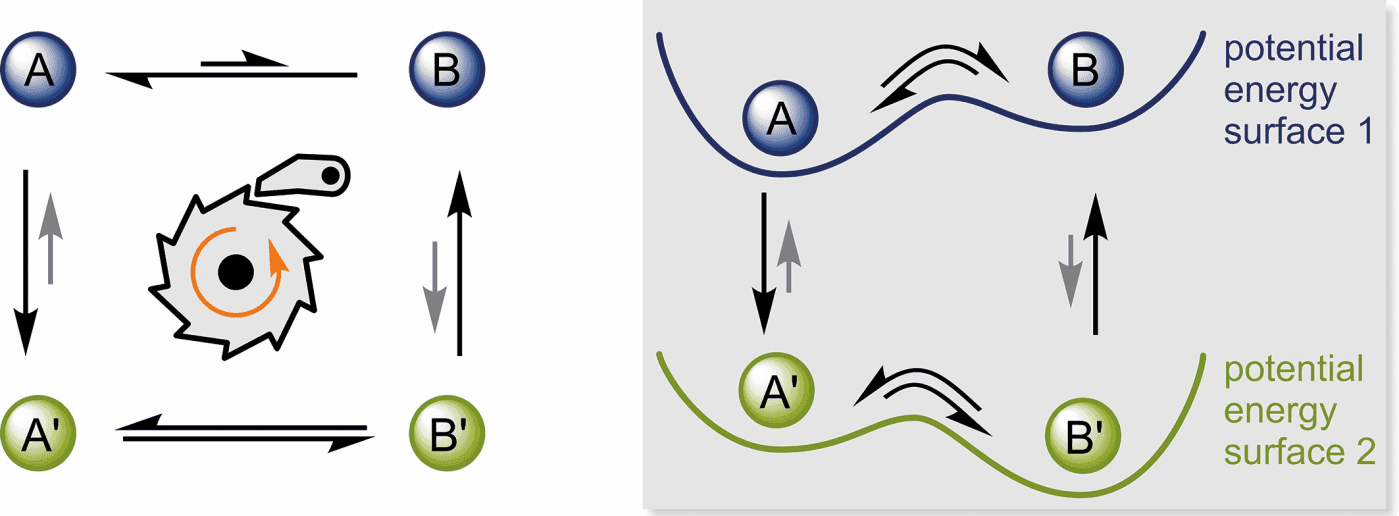
They force chemical reactions to run backwards, driving them energetically uphill. Molecular ratchets trap unstable molecules, spin molecular motors, and even generate electricity from light. The chemical reactions we perform in the lab, whether they are under thermodynamic or kinetic control, form thermodynamically stable products. Nature, on the other hand, often operates away from thermodynamic equilibrium and carries out endergonic reactions. To perform endergonic reactions, nature pairs them with exergonic processes, leveraging the free energy released like a fuel. These reaction cycles are called molecular ratchets. They allow nature to
ArtikelNachrichten aus der Chemie
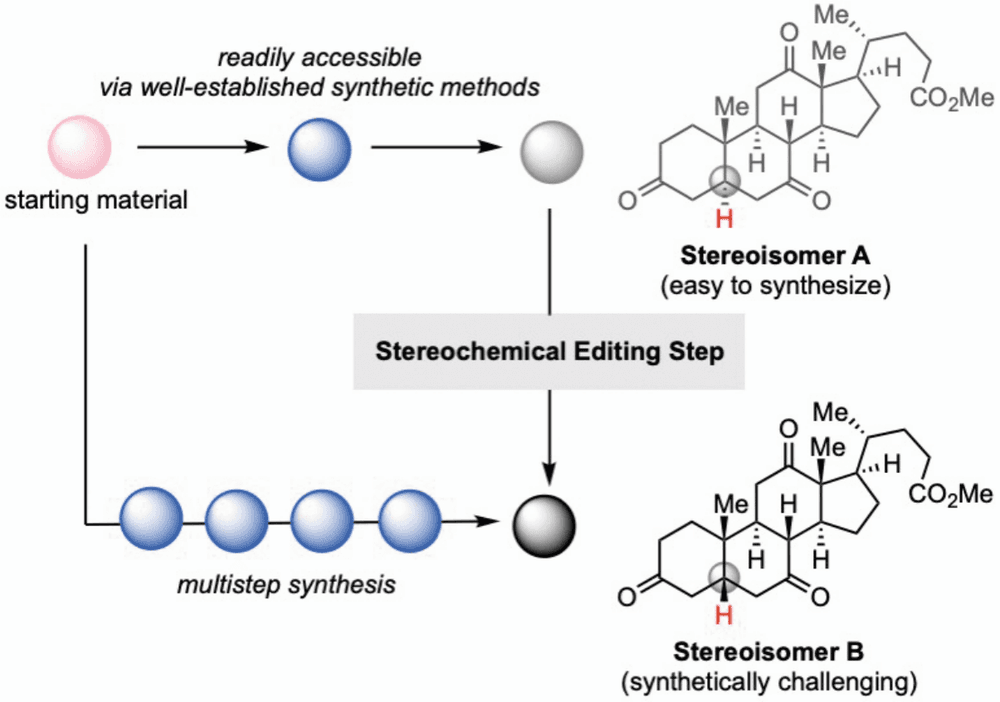
The more functional groups a molecule contains, the more likely a reaction is going to fail. Despite this challenge, researchers have developed mild methods to invert a stereocenter late in the synthesis, opening the door to new chemical structures. When synthesizing chiral organic molecules, one diastereomer or enantiomer is often more easily accessible than the others. This typically occurs for two reasons: either the starting material is an enantiomerically pure natural product (such as l-alanine), making its less common enantiomer (d-alanine) necessary in order to obtain the other stereoisomer; or the chosen reaction intrinsically favors
ArtikelNachrichten aus der Chemie
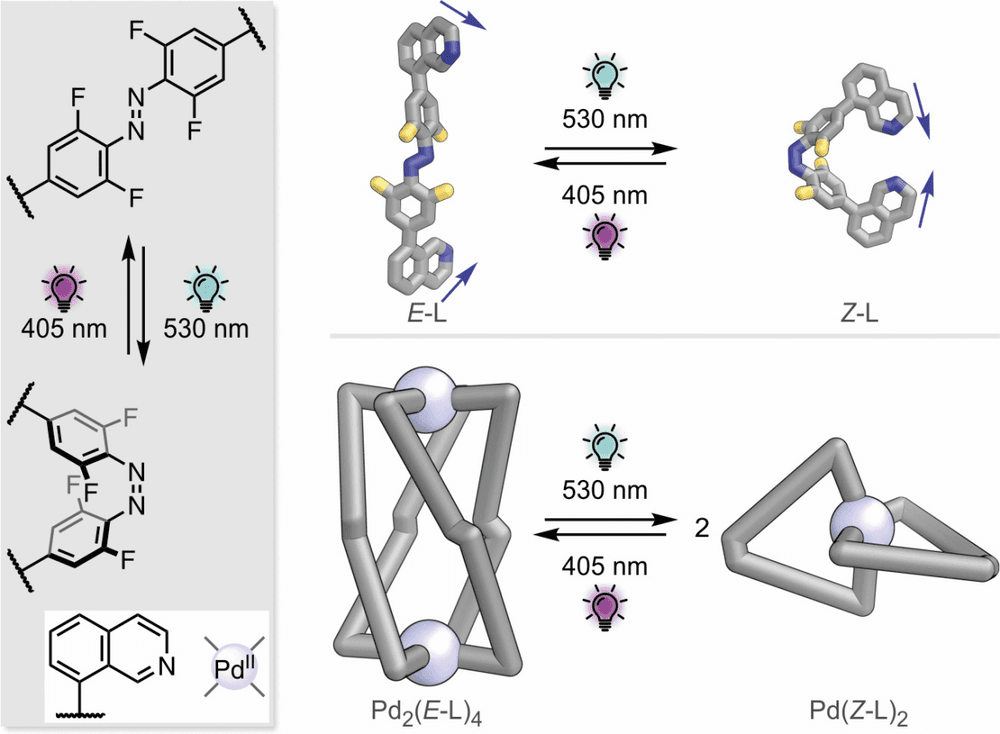
Die Anleitung für eine molekulare Laterne: Metallatom oben und unten sowie eine Hülle aus Liganden. Mit Laternen und anderen metallo-supramolekularen Kapseln lassen sich kleinere Moleküle binden, freigeben und sogar umsetzen. Damit das reversibel möglich ist, braucht es Licht – und das kommt anders als bei echten Laternen von außen. Metallo-supramolekulare Kapseln schließen kleinere Moleküle ein – sie dienen beispielsweise als Sensoren für Dicarboxylate, katalysieren Diels-Alder-Cyclisierungen oder trennen Polyaromaten voneinander (Kasten S. 72). Die geometrische Struktur der Kapsel hängt vor allem von zwei Eigenschaften ab: erstens dem Winke
ArtikelNachrichten aus der Chemie
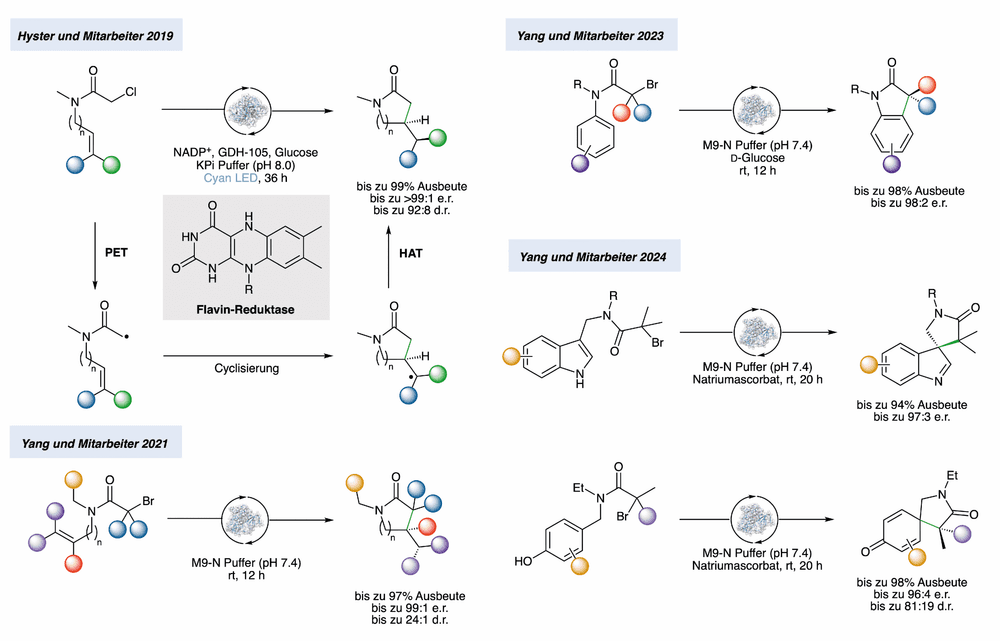
Früher galten Radikale als zu reaktiv, um mit ihnen Stereozentren zu kreieren. Nun haben Forschende Enzyme sogar dazu gebracht, enantioselektiv Radikale zu kuppeln. Für einen Reaktionstyp hält die Natur nur ein einziges Enzym bereit, aber die Menschheit inzwischen so einige. Enantioselektiv Kohlenstoff-Kohlenstoff-Bindungen zu schließen ist oft allein schon schwierig. Dies mit Radikalen zu tun, schien lange unmöglich, da kohlenstoffbasierte Radikale reaktiv sind – und planar. 1) Die Natur addiert jedoch täglich enantioselektiv Radikale: 2,3) Enzyme produzieren so Naturstoffe wie Aminosäuren oder Hormone. 4) Radikalisch cyclisieren Enzyme kata
ArtikelNachrichten aus der Chemie
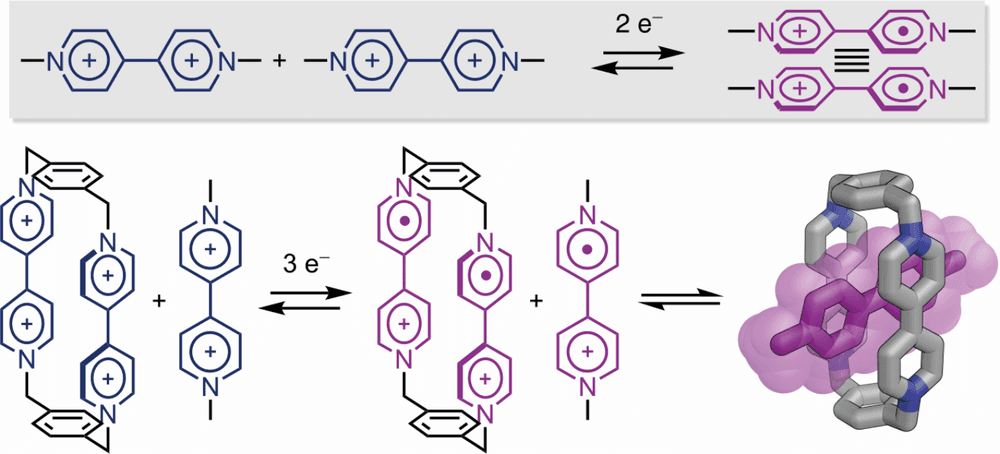
Ein kleines Molekül quartiert sich als Gast beim Wirt ein, einem Makromolekül – Alltag in der supramolekularen Chemie. Allerdings lässt der Wirt den Gast nur unter bestimmten Bedingungen wieder ziehen. Ob dieser freikommt, lässt sich mit Redoxprozessen steuern. Supramolekulare Chemie untersucht komplexe Strukturen, die durch die Selbstorganisation kleinerer Moleküle entstehen. Aufrechterhalten werden die Strukturen durch nicht-kovalente oder dynamisch-kovalente Bindungen – kovalente Bindungen, die in einem schnellen Gleichgewicht zu ihren Edukten stehen. Sie erlauben einen Austausch der Bindungspartner, sodass sie Fehler bei der Selbstorganis
ArtikelNachrichten aus der Chemie
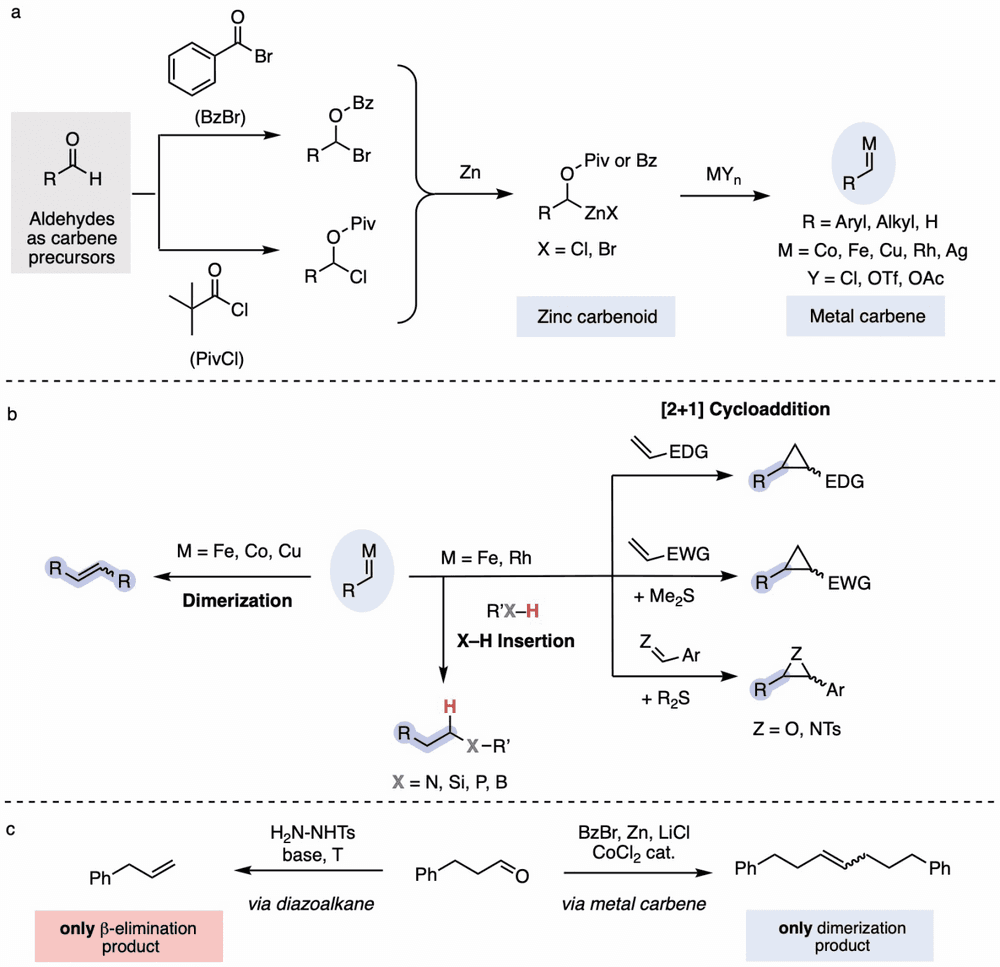
Metal carbenes are involved in cycloadditions, metatheses and C–H functionalizations. However, their main precursors are hazardous diazo compounds, which makes them unfit for industrial use. Recently, however, synthetic strategies overcame this limitation — enabling access to metal carbenes from aldehydes, carboxylic acids and alcohols. Carbenes are an exception to the octet rule: they are neutral species containing a divalent carbon atom with six valence electrons, making them highly reactive. The synthesis of carbenes has traditionally required diazoalkanes as precursors. These compounds contain a diazo functional group that releases nitrog
ArtikelNachrichten aus der Chemie
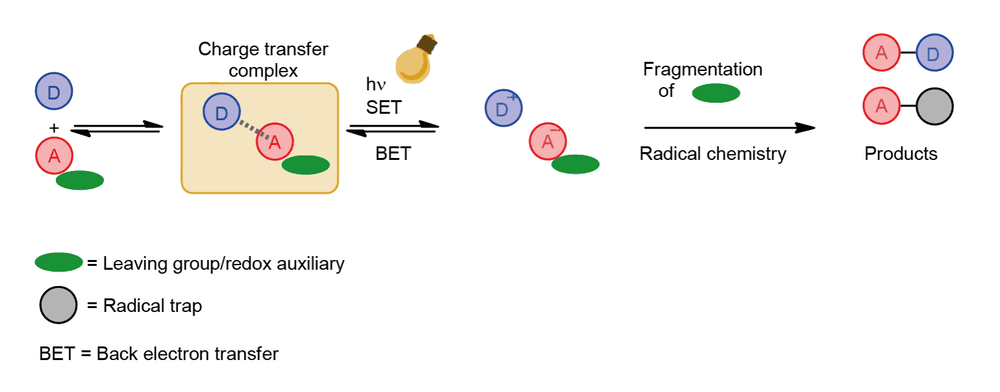
Some photochemical synthesis methods are hampered by back electron transfer, an unproductive relaxation pathway. To prevent this, scientists have identified strategies to promote productive reaction steps: these include leaving groups, redox auxiliaries, and electrostatic interactions. For a photochemical reaction to result in a high-yielding product, competing pathways must be minimized to favor the productive pathway. In photochemical synthesis based on electron transfer one of those competing pathways is back electron transfer. Back electron transfer can hamper the progress of the forward reaction, for example in photochemical methods wher
ArtikelNachrichten aus der Chemie
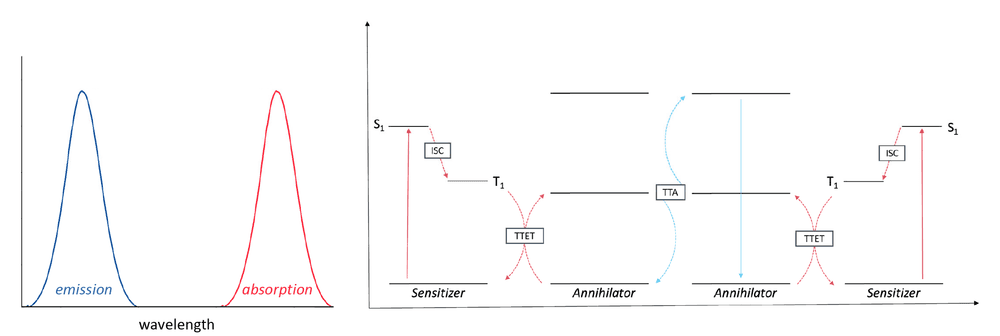
Triplet-triplet annihilation upconversion can generate UV light from visible light LEDs and visible light from infrared. Producing higher-energy photons at the location where they are needed is useful: some functional groups do not tolerate irradation with UV light, and visible light does not penetrate cells and polymers as deep as infrared light. In 1912, Ciamician had the vision of getting the industry to use light instead of heat to make chemical compounds. Light was regarded as an inexpensive, sustainable and renewable reagent to facilitate different chemical reactions. In the 20 th century, most photoinduced transformations used UV-light
ArtikelNachrichten aus der Chemie
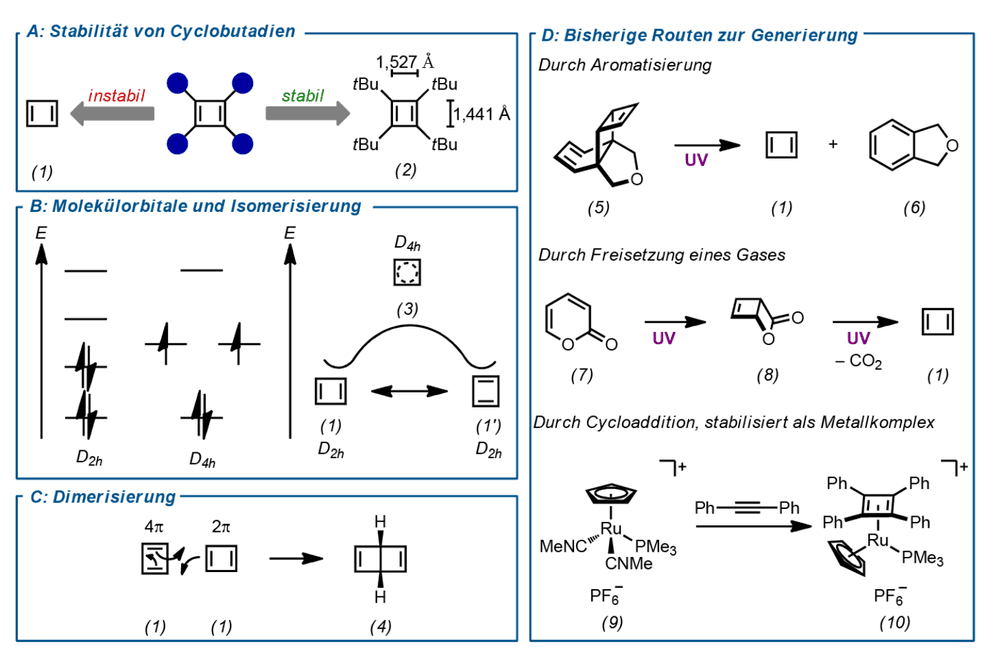
Cyclobutadien, der kleinste Antiaromat, ist sehr reaktiv. Es herzustellen und präparativ zu nutzen ist nicht einfach, aber der Aufwand lohnt sich: Cyclobutadien eignet sich zum Beispiel für [4+2]-Cycloadditionen, eine Cuban- und eine Naturstoffsynthese. Cyclobutadien (CBD) hat vier π-Elektronen und ist damit der kleinste Antiaromat. 1–3) Reaktiv wird es durch die Antiaromatizität (114 ± 11 kcal·mol –1 verglichen mit der konjugierten, offenkettigen Form) und die Ringspannung von 32 ± 2 kcal·mol –1 . 1) Deshalb wurden seine Derivate nur unter besonderen Bedingungen isoliert, beispielsweise mit sterisch anspruchsvollen Substituenten oder in eine