Visible‐Light‐Driven Additive‐Free Photocatalytic Oxidation of Furfural to Maleic Acid and Green Hydrogen
Von Wiley-VCH zur Verfügung gestellt
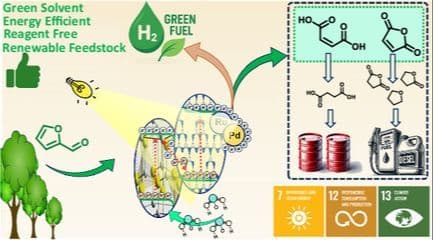
Photocatalytic transformation of biomass-derived furfural into valuable chemicals and fuel additives with simultaneous hydrogen production through water splitting is facilitated by a PdRu alloy nanoparticles-decorated Z-scheme OCN/WO3 photocatalyst.
Developing additive-free photocatalytic systems capable of simultaneously valorizing biomass and producing green hydrogen under visible light remains a key challenge in sustainable chemistry. Herein, a PdRu bimetallic Z-scheme photocatalyst (1.5Pd3Ru@OCN/WO3) that selectively oxidizes furfural while splitting water, yielding a hydrogen evolution rate of 22.33 mmol g−1 h−1 and maleic acid with high productivity (6.69 mmol g−1 h−1) and selectivity (85%) is presented. The product selectivity between maleic acid and maleic anhydride can be precisely controlled by adjusting the solvent conditions. The performance of the catalyst is attributed to the decorated PdRu alloy nanoparticles, which provide intimate contact and exploit the low Fermi level of metals for electron trapping and proton activation, confirmed by photoelectrochemical studies. The OCN/WO3 Z-scheme heterojunction facilitates directional charge migration, confirmed through Ultraviolet Photoelectron Spectroscopy (UPS), Valence Band X-ray Photoelectron Spectroscopy (VB-XPS), Mott–Schottky (MS), and in situ XPS analyses. Further investigation of charge dynamics using photoluminescence, electrochemical impedance spectroscopy, transient photocurrent measurements, and time correlated single photon counting reveals prolonged charge carrier lifetimes and reduced recombination. Electron Paramagnetic Resonance (EPR), DMPO spin-trapping, and Electrospray Ionization Mass Spectrometry (ESI-MS) studies elucidate a radical-mediated oxidation pathway involving O2•−, •OH, and a key intermediate (C5H3O2•). A comprehensive green metrics assessment under batch process demonstrates excellent atom economy, low E-factor, and high material recovery, validating the catalyst's sustainability.