Testing Protocols for Obtaining Reliable Pair Distribution Functions from Laboratory X‐Ray Sources Using PDFgetX3
Von Wiley-VCH zur Verfügung gestellt
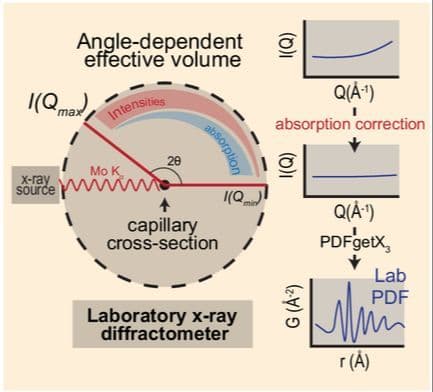
This work explores data acquisition and reduction protocols for atomic pair distribution scheme that enhances high-angle data collection, and the effects of instrumental parameters on resulting pair distribution functions are examined. A correction for sample absorption in PDFgetX3 is introduced.
Herein, data acquisition protocols are explored and data reduction protocols are improved using PDFgetX3 to obtain reliable data for atomic pair distribution function (PDF) analysis from a laboratory-based Mo K α X-ray source. A variable counting scheme is described that preferentially counts in the high-angle region of the diffraction pattern. The effects on the resulting PDF are studied by varying the overall count time, the use of Soller slits, and limiting the out-of-plane divergence of the incident beam. The protocols are tested using an amorphous silica and a quartz sample. A Python script is presented that allows the comparison of PDFs obtained from different instruments and different acquisition protocols and does automatic uncertainty estimation and error propagation. A modification to the current PDFgetX3 data corrections to take care of sample absorption is also presented, which was previously neglected in the use of that program for high-energy synchrotron X-ray data.