Reactivity of Imidazole‐ and Pyridine‐Carboxaldehydes for Gem‐Diol and Hemiacetal Generation: Theoretical and Experimental Insights
Von Wiley-VCH zur Verfügung gestellt
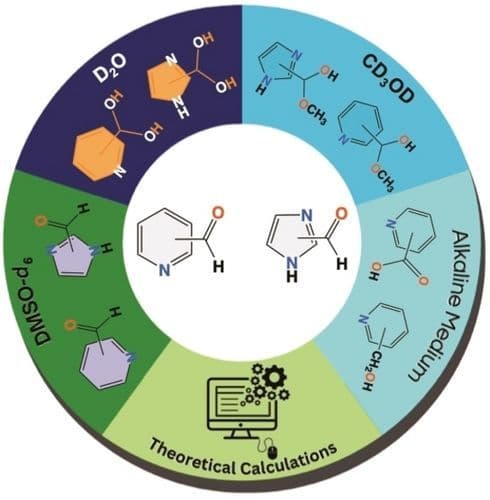
The generation of the gem-diol and hemiacetal forms using pyridine- and imidazole-carboxaldehyde isomers in different chemical environments was studied by NMR spectra and combined with theoretical calculations. Unlike aprotic solvents, protic ones, as water and methanol, favored the generation of the gem-diol and hemiacetal structures.
Abstract
Gem-diols are defined as organic molecules carrying two hydroxyl groups at the same carbon atom, which is the result of the nucleophilic addition of water to a carbonyl group. In this work, the generation of the hydrated or hemiacetal forms using pyridine- and imidazole-carboxaldehyde isomers in different chemical environments was studied by Nuclear Magnetic Resonance (NMR) recorded in different media and combined with theoretical calculations. The change in the position of aldehyde group in either the pyridine or the imidazole ring had a clear effect in the course of the hydration/hemiacetal generation reaction, which was favored in protic solvents mainly in the presence of methanol. For pyridinecarboxaldehydes, the acidity/basicity degree of the reaction medium influenced not only the generation of the gem-diol or hemiacetal forms but also the oxidation to the corresponding carboxylic acid. However, imidazolecarboxaldehyde was found to be less reactive to the nucleophilic addition of water and methanol than the other compounds in all the environments evaluated. Furthermore, both the gem-diol/hemiacetal generation and the Cannizzaro reaction products were studied in alkaline medium.