PPARγ Agonistic Activity of Mimulone and Diplacone Encapsulated in Liposomes and Cyclodextrin Complexes
Von Wiley-VCH zur Verfügung gestellt
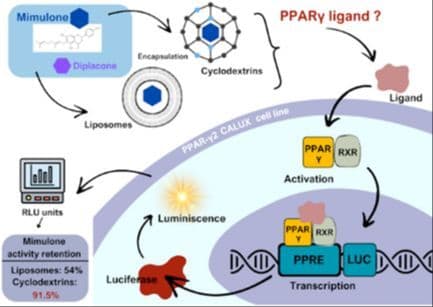
Encapsulation of the geranylated flavanones mimulone and diplacone in hydroxypropyl-β-cyclodextrins (HP-β-CDs) and liposomes is evaluated for their peroxisome proliferator-activated receptor gamma agonistic activity. While liposomes reduce efficacy, HP-β-CDs preserve up to 91.5% of mimulone's activity and mitigate diplacone's cytotoxicity, highlighting cyclodextrins as promising flavonoid carriers.
The therapeutic application of flavonoids is limited by their low solubility, bioavailability, and metabolic stability. This study evaluates the peroxisome proliferator-activated receptor gamma (PPARγ) agonistic activity of two geranylated flavonoids from Paulownia tomentosa, mimulone and diplacone, and compares the efficacy of different nanoparticle delivery systems, including liposomes and cyclodextrins, in preserving their biological activity. Using the PPARγ CALUX reporter gene assay, it is shown that mimulone dissolved in DMSO and incubated with cell culture activates the PPARγ pathway, resulting in 2.97-fold and 3.9-fold increases in luciferase activity at concentrations of 5 and 2.5 μM, respectively. Diplacone, however, shows significant cytotoxicity, with an average cell viability of about 10% at 10 μM. Encapsulation in anionic, cationic, and neutral liposomes results in a significant reduction of biological activity of both flavonoids, with the best formulation (anionic liposomes) preserving only 54% of mimulone's activity. In contrast, hydroxypropyl-β-cyclodextrins (HP-β-CDs) retain up to 91.5% of mimulone's biological activity and significantly improve the viability profile of diplacone, maintaining cell viability at ≈100%. The performance of the HP-β-CDs can be attributed to their ability to form stable inclusion complexes with hydrophobic molecules. These results suggest that cyclodextrin-based delivery systems might effectively address solubility and stability challenges associated with flavonoid therapy.