Photophysical and Chiroptical Properties of Europium(III) Enantiomers with Axially Chiral Ancillary Ligands
Von Wiley-VCH zur Verfügung gestellt
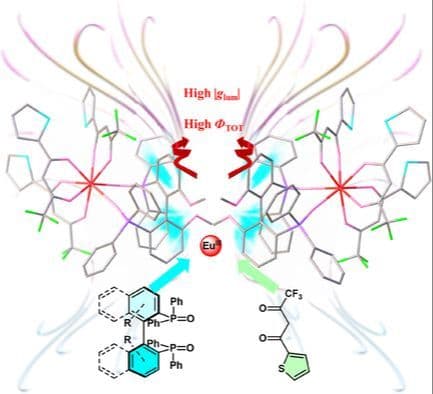
Chiral Eu(III) complexes with β-diketone 1,1,1-trifluoro-3-(2-thenoyl)acetonato and axially chiral ancillary ligands, R/S-[1,1′-binaphthalene]-2,2′-diylbis(diphenylphosphine oxide), R / S-(6,6′-dimethoxy-[1,1′-biphenyl]-2,2′-diyl)bis(diphenylphosphine oxide), and R/S-[4,4′-bibenzo[d][1,3]dioxole]-5,5′-diylbis(diphenylphosphine oxide) exhibit high photoluminescence efficiencies (0.49, 0.42, and 0.56, respectively) and strong circularly polarized luminescence with dissymmetry factor (|g lum|) of up to 0.070, 0.131, and 0.147, respectively, demonstrating efficient ligand-to-metal energy transfer and tunable chiroptical properties.
Chiral lanthanide(III) complexes with superior circularly polarized luminescence (CPL) properties, especially for the efficient chiral europium(III) complexes with high dissymmetry factor (g lum) obtained by rational design of coordination ligands, are important in the field of chiral functional materials. In this work, the β-diketone ligand 1,1,1-trifluoro-3-(2-thenoyl)acetonato (TTA) is used as the primary ligand and three axially chiral enantiomeric pairs, R/S-[1,1′-binaphthalene]-2,2′-diylbis(diphenylphosphine oxide) (R/S-BINAPO), R/S-(6,6′-dimethoxy-[1,1′-biphenyl]-2,2′-diyl)bis(diphenylphosphine oxide) (R/S-BINAPO), and R/S-[4,4′-bibenzo[d][1,3]dioxole]-5,5′-diylbis(diphenylphosphine oxide) (R/S-DiO-BIPHPO), are used as ancillary ligands for three pairs of chiral Eu(III) enantiomers. The photoluminescence efficiencies of Eu(TTA)3(BINAPO), Eu(TTA)3(MeO-BIPHPO), and Eu(TTA)3(DiO-BIPHPO) are as high as 0.49, 0.42, and 0.56, respectively. Furthermore, Eu(TTA)3(R/S-BINAPO), Eu(TTA)3(R/S-MeO-BIPHPO), and Eu(TTA)3(R/S-DiO-BIPHPO) enantiomers exhibit symmetric CPL spectra with g lum factors at the magnetic-dipole transition (5D0 → 7F1) as high as 0.067/–0.070, 0.128/–0.131, and 0.138/–0.147, respectively. These results suggest that an effective ligand-to-metal energy transfer occurs, and the chiral ancillary ligands affect the chiroptical properties of the Eu(III) enantiomers effectively.