Nitrile N‐Oxide‐Based Fluorescent Probe to Impart Aggregation‐Induced Emission to Alkenes
Von Wiley-VCH zur Verfügung gestellt
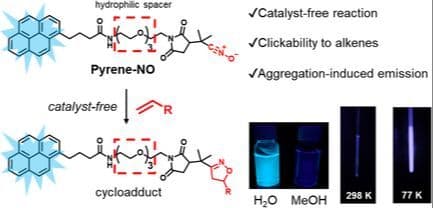
Fluorescent probes have been used extensively in chemical biology. However, there are a few fluorescence probes that covalently bind to less polar compounds without a catalyst. Herein, the design, synthesis, and click reaction of pyrene-based nitrile N-oxide (Pyrene-NO) are reported. The optical properties of the adducts of Pyrene-NO indicate that Pyrene-NO imparts the aggregation-induced emission behaviors to alkene-containing compounds.
Fluorescent probes have been used extensively in chemical biology, allowing the visual observation of bioactive compounds. While many variations of fluorescent probes that react to polar functional groups have been developed, there are few fluorescent probes that directly modify less polar compounds. In this article, pyrene-containing nitrile N-oxide (Pyrene-NO) has been designed and synthesized as a fluorescent dye clickable to alkenes without a catalyst. Pyrene-NO shows good reactivity to a terminal alkene, a polymer methacrylate, and a natural unsaturated lipid with internal alkenes to give the corresponding cycloadducts with pyrene as the fluorescent dye. The cycloadducts show aggregation-induced emission (AIE) behaviors in a poor solvent. While the adducts to 1-hexene or polymer methacrylate show AIE in water, the adduct to castor oil, as a natural glycerolipid, shows AIE in MeOH. The AIE behaviors are evidenced by the dependence of fluorescence intensity on the concentration and the enhanced fluorescence at 77 K compared with that at room temperature. It is suggested that the aggregation of the cycloadduct in the poor solvent would kinetically suppress the nonradiative deactivation of the excited state of pyrene based on interactions with oxygen, leading to an increase in fluorescence intensity.