Metal‐Free Organocatalytic Formylation by CO2‐Masked Carbene Functionalized Graphene Oxide Nanosheets
Von Wiley-VCH zur Verfügung gestellt
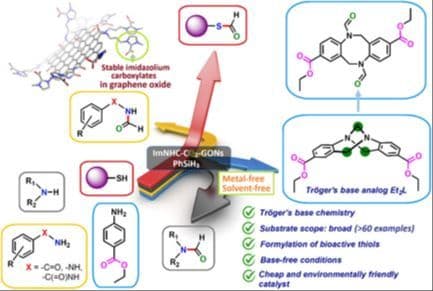
Here, the authors show the use of an organocatalytic process for the metal-free N-/S-formylation of various NH and SH functionalities using a CO2-protected NHC-functionalized graphene oxide nanosheets. The authors discovered the direct N-formylation of the in situ-generated Tröger's base linker through reductive catalytic conversion of CO2.
Despite considerable scientific advancements, there is an urgent need for sustainable, cost-effective, and efficient methods for chemically transforming CO2 into valuable chemicals. A stable heterogeneous platform is presented that incorporates four key innovations: 1) the first Tröger's base (TB) chemistry in solids via selective four-electron reductive functionalization of CO2, 2) an effective heterogeneous organocatalyst for the chemoselective formylation of both NH and SH functionalities with CO2, 3) a methodology for metal-free heterogeneous S-formylation of bioactive thiols, and 4) a direct covalent immobilization of CO2-protected N-heterocyclic carbenes (NHCs) on graphene oxide nanosheets (GONs). The CO2-protected catalyst is developed by covalently attaching imidazole (Im) to GONs and functionalizing them with dimethyl carbonate. The resulting CO2-protected NHC-functionalized GONs serves as an effective catalyst for the metal-free, selective formylation of NH and SH bonds under mild conditions. To address gaps in the understanding of TB chemistry in GONs, a metal-free formylation method is discovered that utilizes an in situ-generated TB linker produced by converting CO2 with excess silane. The ability of this catalyst to revert to its CO2-protected state enables excellent recyclability. This accessible and efficient platform offers an unprecedented pathway for sustainable CO2 conversion, supported by both theoretical and experimental evidence.