In‐Silico Exploration of the StreptomeDB Database for Potential Irreversible DprE1 Inhibitors toward Antitubercular Treatment
Von Wiley-VCH zur Verfügung gestellt
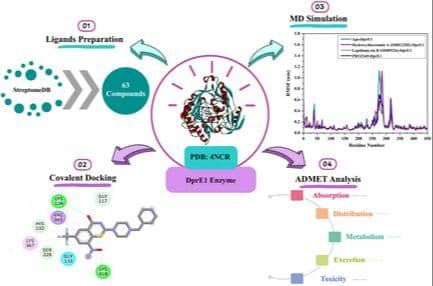
StreptomeDB-derived nitro compounds are screened against Mycobacterium tuberculosis decaprenylphosphoryl-D-riboseoxidase (DprE1) . Covalent docking, molecular dynamics simulations, and molecularmechanics/generalized Born surface area analyses identify hydroxythaxtomin and lajollamycin B as potent DprE1 inhibitors, surpassing the reference PBTZ169 in binding affinity. Drug-likeness and bioavailability profiles support their potential as antituberculosis candidates.
Tuberculosis (TB) is one of the most fatal infectious diseases. Decaprenylphosphoryl-D-ribose oxidase (DprE1), one of the key enzymes in the synthesis of arabinogalactan and lipoarabinomannan, has become a focal point for anti-TB drug discovery. An investigation of the StreptomeDB database, an extensive collection of natural products from Streptomyces species, yielded 63 nitro-containing compounds with strong potential as masked electrophiles for covalent inhibitors. The compounds are prepared and screened against DprE1. The reliability of AutoDock 4.2.6 software in predicting the covalent docking scores and poses of the DprE1 inhibitors is evaluated. StreptomeDB compounds exhibiting covalent docking scores lower than PBTZ169, the reference inhibitor, against DprE1 (calc. –7.8 kcal mol−1) are recognized and underwent molecular dynamics simulations, succeeded by estimations of MM-GBSA binding energies. According to the MM-GBSA results obtained after 300 ns MDS, hydroxythaxtomin A and lajollamycin B exhibited better binding affinities against DprE1 with ΔGbinding$\Delta G_{\text{binding}}$ values of –51.2 and –50.5 kcal mol−1, respectively, compared to PBTZ169 (calc. –49.3 kcal mol−1). Post-MD analyses are conducted to examine the stability and affinity of the identified StreptomeDB compounds with DprE1. Robust bioavailability and drug-likeness characteristics are expected for the investigated StreptomeDB compounds. These findings unveiled promising inhibitory activity for hydroxythaxtomin A and lajollamycin B against DprE1.