Impregnation of Melaleuca Family Essential Oil Nanoemulsions into Pectin:Polyvinyl Alcohol Patches to Provide an Antibacterial Environment for Infected Wounds
Von Wiley-VCH zur Verfügung gestellt
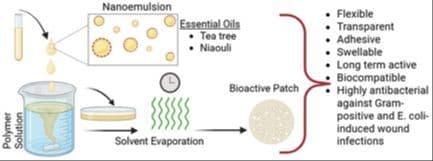
This study reports the fabrication, characterization, and biological evaluation of bioactive patches made from pectin:polyvinyl alcohol with tea tree and niaouli oil nanoemulsions via solvent evaporation. The patches are flexible, transparent, adhesive, and absorbent. They are biocompatible and show long-term antimicrobial activity against E. coli and Gram-positive bacteria, making them suitable for wound infection treatments.
Essential oils have long been utilized in food, cosmetic, and medicinal applications. Recently, their biomedical use for wound healing, skin repair, and tissue regeneration has gained considerable attention. In this study, tea tree oil (TTO) and niaouli oil (NIO) were formulated into aqueous nanoemulsions (NEs) and incorporated into pectin/polyvinyl alcohol (PP) thin films to develop antibacterial wound dressing patches. The NEs were characterized by dynamic light scattering (DLS), and their morphological and chemical structures were also analyzed. The patches’ morphology, hydrophilicity, swelling ratio, and mechanical properties were evaluated to assess the effect of NEs on material performance. Antibacterial activity assessed by plate count and agar diffusion methods against six bacteria commonly associated with infected wounds showed significant efficacy of NEs-loaded patches against Gram-negative strains and Escherichia coli. Direct and indirect cytotoxicity tests, using Mouse embryonic fibroblast (MEF) cells, confirmed that NEs incorporation maintained cell viability within acceptable limits and promoted their biocompatibility. These findings suggest that TTO and NIO-based nanoemulsion patches are promising candidates for antibacterial wound dressings.