From Fabrication to Failure—Aqueous Processing, Electrolyte Tuning, and Degradation Mechanism Elucidation in Poly(3‐Vinyl‐N‐Methylphenoxazine) Positive Electrodes
Von Wiley-VCH zur Verfügung gestellt
Organic electrode materials are considered the next generation of battery electrode materials due to their environmental friendliness, low toxicity and competitive specific capacities. Herein, we report on a systematic study of processing of the redox polymer poly(3-vinyl-N-methylphenoxazine) (PVMPO) using water processable binders, achieving comparable performance to that of PVdF-based electrode.
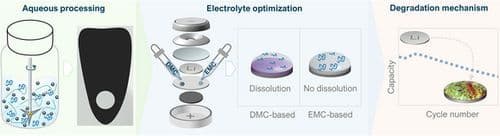
Organic electrode materials are considered the next generation of battery electrode materials due to their environmental friendliness, low toxicity, and competitive specific capacities. Herein, a systematic study of the processing of the redox polymer poly(3-vinyl-N-methylphenoxazine) (PVMPO) using water-processable binders, achieving comparable performance comparable to that of PVdF-based electrode, is reported. To address the dissolution of the oxidized polymer into the electrolyte, two different electrolytes are investigated to maximize specific capacity. The use of 1.0 m LiPF6 in 3:7 EC:EMC electrolyte inhibits the dissolution of the oxidized polymer, as confirmed by UV–Visible spectroscopy, ex situ scanning electron microscopy (SEM) analysis after the 1st charge and 1st discharge, and cyclic voltammetry measurements. The inhibition results in 79% capacity retention at the end of 500 cycles. Additionally, the polymer demonstrates notable rate capability even at 100C, with capacity retention of 82% after 10,000 cycles. This performance is attributed to the faster kinetics resulting from the planar geometry of phenoxazine units in PVMPO. However, notable capacity fading is observed after 200 cycles when cycling at 1C rate, found to be due to polymer decomposition. This study opens up a new avenue for exploring aqueous processing of redox polymers and potential reasons for capacity fading.