Cellulose‐Based Nanosponges Loaded with Palladium as Efficient Heterogeneous Catalysts for the Synthesis of Challenging Derivatives with Pharmaceutical Relevance
Von Wiley-VCH zur Verfügung gestellt
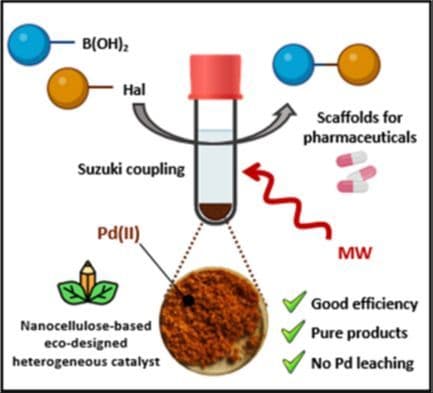
This work presents a cellulose-based heterogeneous palladium catalyst (CNS-Pd) for the efficient and selective Suzuki–Miyaura synthesis of pharmaceutically relevant heterocyclic derivatives, including scaffolds derived from unstable boronic molecules. The study emphasizes the use of mild conditions, high yields, and reduced palladium leaching, offering a sustainable alternative to conventional homogeneous systems in complex molecule synthesis.
Developing efficient catalytic systems is crucial for synthesizing complex heterocyclic compounds used in pharmaceuticals. However, key motifs, like pyridine and furan derivatives, pose challenges due to regioselectivity and sensitivity to harsh conditions. Conventional homogeneous palladium-catalyzed cross-coupling reactions, while effective, suffer from catalyst recovery issues, palladium contamination, and environmental concerns. To overcome these limitations, this study explores cellulose-based nanosponges as sustainable palladium supports for heterogeneous catalysis, enhancing stability and green chemistry integration. These nanostructured materials, synthesized from cellulose, provide a high-surface-area scaffold that enhances uniform palladium dispersion, with a 22% w/w overall loading measured using inductively coupled plasma optical emission spectroscopy, and prevents metal leaching, integrating green chemistry principles and a safe-and-sustainable-by-design approach. In this work, the optimization of Suzuki–Miyaura couplings using CNS-Pd under mild conditions, showcasing the efficiency and selectivity of this heterogeneous catalyst in the synthesis of pharmaceutically relevant heterocyclic derivatives, is presented. Notably, high reaction yields (65%–99%) even with unstable boronic derivatives are achieved, which are typically synthesized using homogeneous catalysts, often with poor yields, selectivity and purity of the final products. The obtained results underscore the potential of biopolymer-based catalysts to drive innovation in sustainable pharmaceutical synthesis, effectively bridging the gap between heterogeneous catalysis and pharmaceutical chemistry.