Biogenic Growth of Magnetic Retrievable Ca4Fe9O17 Anchored on Rice Husk Biochar for Methylene Blue Degradation through Persulfate Activation
Von Wiley-VCH zur Verfügung gestellt
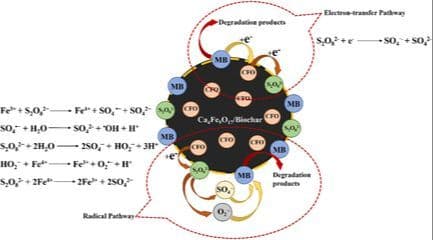
Methylene blue dye degradation using Ca4Fe9O17/biochar nanocomposite through persulfate activation.
The presence of dyes in wastewater has gained significant attention due to rapid industrialization. Methylene blue (MB) is a widely used cationic dye in the textile industry, but it poses several issues due to its toxicity and persistence in the environment. Herein, the Ca4Fe9O17/biochar (CFO/BC) nanocomposite by the coprecipitation method for persulfate activation have been successfully fabricated. The as-synthesized catalyst shows effective removal of MB dye with 96.33% efficiency in just 40 min. The fabricated catalyst shows 54% total organic carbon removal of MB dye. The catalyst is characterized by Fourier-transform infrared spectroscopy, X-ray powder diffraction, X-ray photoelectron spectroscopy, Brunauer-Emmett-Teller analysis, scanning electron microscopy, and vibrating-sample magnetometer. The average crystalline size and crystallinity of the CFO/BC nanocomposite are found to be 31.74 nm and 49%, respectively. The mechanism of MB degradation by CFO/BC nanocomposite follows both the electron-transfer pathway and radical pathway, as shown by the scavenging test. The scavenger study shows the presence of reactive species such as sulfate radical (SO4 •−), hydroxyl radical (•OH), and electrons for the degradation of MB dye. The liquid chromatography-mass spectrometry analysis is used to investigate the possible degradation pathway of MB dye. Moreover, the catalyst shows four-time reusability, highlighting its practical potential.