Analytical Study of Lanolin as Potential Biomarker of Prehistoric Sheep‐Shearing Practice
Von Wiley-VCH zur Verfügung gestellt
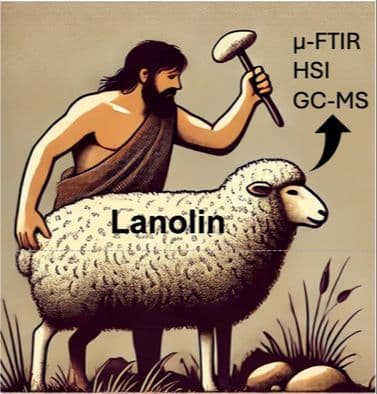
Lanolin, a complex wax found on sheep wool, accumulates on shearing tools, such as flint and obsidian blades, used since the Neolithic. This study explores lanolin's degradation patterns as a potential biomarker for prehistoric sheep-shearing practices, employing micro-Fourier transformed infrared spectroscopy, hyperspectral imaging, and gas chromatography coupled with mass spectrometry under experimental archeological conditions.
Sheep-shearing practices probably started in the Neolithic Age when the genetic selection of sheep began to be successful in obtaining animals with abundant wool. Flint and obsidian were the main materials probably used to manufacture tools for this purpose. From shearing, lanolin wax is accumulated onto the shearing tools. Lanolin is a complex mixture of esters and polyesters, alcohols, fatty acids, and hydrocarbons produced mainly by sheep to protect the skin and the wool from environmental agents. Due to its complex chemistry, lanolin is relatively difficult to characterize. This work investigates the possible use of lanolin as a biomarker of sheep-shearing practices in the prehistoric era. For this purpose, lanolin degradation pathways have been studied by an experimental archeology approach adjuvated by Fourier transformed infrared spectroscopy, hyperspectral imaging, and gas chromatography coupled with mass spectrometry.