An Unusual Activity of Conformationally Restricted Naphthalene Peri‐Dichalcogenides in the Reduction of Nitro and Azide Groups
Von Wiley-VCH zur Verfügung gestellt
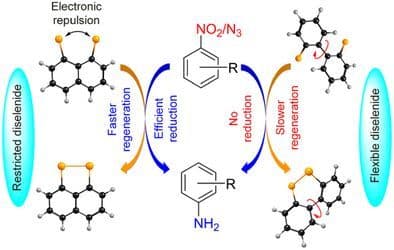
This work highlights the unique ability of a conformationally restricted dichalcogenide to reduce nitro and azide groups to their corresponding amines under physiological conditions. The redox potential is strongly influenced by the nature of chalcogen atom substitution as well as the conformational rigidity of the dichalcogenide bond.
Abstract
Rigid and conformationally restricted dichalcogenides based on 1,8-naphthyl system have attracted significant interest as electron donors in charge transfer complexes and organic electrode materials. Recently, naphthalene-1,8-peri-diselenides have been shown to mimic the function of two major selenoenzymes − iodothyronine deiodinase (Dio) and glutathione peroxidase (GPx) − mainly through two-electron redox processes involving deiodination of thyroid hormones and thiol-mediated reduction of hydrogen peroxide, respectively. Herein, we report that naphthalene-1,8-peri-dichalcogenides can mediate a six-electron reduction of organic nitro compounds to produce the corresponding primary amines at physiologically relevant temperature (37 °C) using water as the solvent. The stepwise reduction process is highly dependent on the nature of the chalcogen atom present at the peri-positions of the naphthyl ring. While no reduction was observed with the disulfide, the selenenyl sulfide mediated a four-electron reduction of the nitro group to the corresponding hydroxylamine. The diselenide and ditelluride reduced the nitro groups all the way to amines through six-electron transfer. The diselenides also mediated the reduction of various aromatic azides to the corresponding primary amines.