Adjustment of the Proton‐Accepting Ability of Π‐Bonds and Lone Pairs
Von Wiley-VCH zur Verfügung gestellt
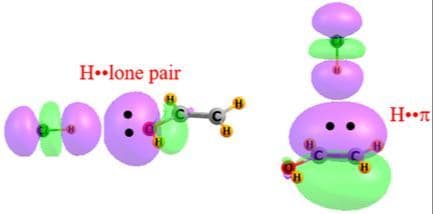
The relative potency of an O lone pair to attract a proton donor within an H-bond is compared with that of the π-electron system above one or more CC double bonds. Although the O is surrounded by a more negative electrostatic potential, this advantage can be overcome by the placement of suitable substituents on the parent molecule. The aromatic phenol is particularly susceptible to this reversal in stability, which is attributed to a large contribution from dispersion.
A hydroxyl group is placed on a series of systems containing CC double bonds, and quantum chemical calculations consider the preferred target of an incoming1 HCl molecule to form an H-bond. The O lone pairs are favored over the π-system in most instances but can be reversed by the presence of electron-donating substituents. This reversal occurs when NH2 groups are added to a simple alkene or if NMe2 substituents are placed on a conjugated butadiene derivative. There are a variety of means of favoring the aromatic ring as a proton-accepting site over the phenol O. Dispersion is the primary factor in determining the preferred electron-donor site in the aromatic systems. The particular site and orientation of attachment of HCl to the π system is controlled by a combination of electrostatic potential and HOMO disposition.