A Fuel‐Driven Lock‐and‐Key System
Von Wiley-VCH zur Verfügung gestellt
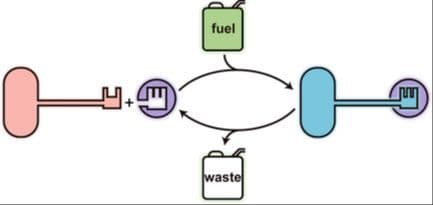
A fuel-driven lock-and-key system is based on crown ether (L) and ammonium ions, showing reversible binding between deprotonated key (D-K) and protonated key (P-K). Energy input drives D-K to P-K, while fuel consumption reverses the process, enabling controlled molecular recognition and state transitions.
This study introduces a fuel-driven lock-and-key system based on the interaction between crown ether and ammonium ion. In this simple model system, a key-like molecule with an amino group functions as the key, while 15-crown-5 serves as the lock. The chemical fuel, 2-cyano-2-phenylpropanoic acid, protonates the key, transitioning it from its deprotonated state to a protonated state, enabling it to bind to the lock. Upon fuel consumption, the protonated key reverts to its deprotonated state, causing the dissociation from the lock. This cycle is reversible and can be repeated at least three times. We hope that this intuitive lock-and-key system can provide a clearer understanding of energy-driven molecular recognition and offer valuable insights into the design and development of energy-driven molecular systems based on molecular recognition.